
Ethereum execution layer,
in TypeScript.
Modular, browser-ready protocol libraries — EVM, blocks, transactions, state — maintained by core contributors and open to the broader Ethereum dev community.
Built from the community
EthereumJS is one of the oldest JavaScript/TypeScript Ethereum stacks in the ecosystem — alongside Go Ethereum on the execution layer — with deep community roots going back to the early days of Ethereum.
The project grew out of the community, was nurtured for years within the Ethereum Foundation JavaScript team, and has since transitioned back to an independent community effort: a small core of maintainers, diversely funded, actively shipping protocol updates.
You don't need permission to get involved — open an issue, join a discussion, send a PR. Whether you're building dApps, researching EIPs, or just curious about how the protocol works in readable TypeScript, you're welcome here.




The stack
The ethereumjs-monorepo holds modular
building blocks of the Ethereum execution layer — each package installable via npm, composable,
and kept in sync through a shared @ethereumjs/common hardfork engine.
- Browser-ready
- Official test suite
- Tree-shakeable
- Osaka / Amsterdam in dev
- @noble crypto
Execution
Protocol
Block header and body schema, validation, serialization.
Chain management — block processing, reorgs, PoW/PoS helpers.
All transaction types — legacy, EIP-1559, blobs, EIP-7702, and more.
Genesis block and state initialization.
Chain configs, hardfork scheduling, EIP activation — the glue.
State & encoding
Modified Merkle Patricia Trie — proofs, checkpoints, flexible backends.
Binary tree trie implementation for statelessness research.
Recursive Length Prefix encoding and decoding.
Addresses, accounts, signatures, byte helpers, and shared types.
Historical block data storage format (E2HS / Portal History).
* @ethereumjs/client is deprecated — see the
monorepo README for details.
See it in code
Run bytecode in the EVM
Five lines to instantiate an EVM and execute simple bytecode.
import { createEVM } from '@ethereumjs/evm'
import { hexToBytes } from '@ethereumjs/util'

const evm = await createEVM()
const res = await evm.runCode({
  code: hexToBytes('0x6001'), // PUSH1 01
})
console.log(res.executionGasUsed) // 3n
Run a transaction locally
Simulate an ETH transfer with the VM — no RPC node required.
import { Common, Hardfork, Mainnet } from '@ethereumjs/common'
import { createLegacyTx } from '@ethereumjs/tx'
import { createAccount, createAddressFromPrivateKey,
  createZeroAddress, hexToBytes } from '@ethereumjs/util'
import { createVM, runTx } from '@ethereumjs/vm'

const common = new Common({ chain: Mainnet,
  hardfork: Hardfork.Shanghai })
const vm = await createVM({ common })

const key = hexToBytes(`0x${'20'.repeat(32)}`)
const sender = createAddressFromPrivateKey(key)
await vm.stateManager.putAccount(sender,
  createAccount({ nonce: 0n, balance: 10n ** 18n }))

const tx = createLegacyTx({
  gasLimit: 21000n, gasPrice: 1_000_000_000n,
  value: 1n, to: createZeroAddress(),
}).sign(key)

const res = await runTx(vm, { tx })
console.log(res.totalGasSpent) // 21000n
Create a typed transaction
EIP-1559 fee-market transactions with a unified API across all tx types.
import { Common, Hardfork, Mainnet } from '@ethereumjs/common'
import { createFeeMarket1559Tx } from '@ethereumjs/tx'

const common = new Common({ chain: Mainnet,
  hardfork: Hardfork.London })

const tx = createFeeMarket1559Tx({
  gasLimit: 21000n,
  maxFeePerGas: 20_000_000_000n,
  maxPriorityFeePerGas: 1_000_000_000n,
  value: 1n,
  to: '0x000000000000000000000000000000000000dEaD',
}, { common })

console.log(tx.type) // 2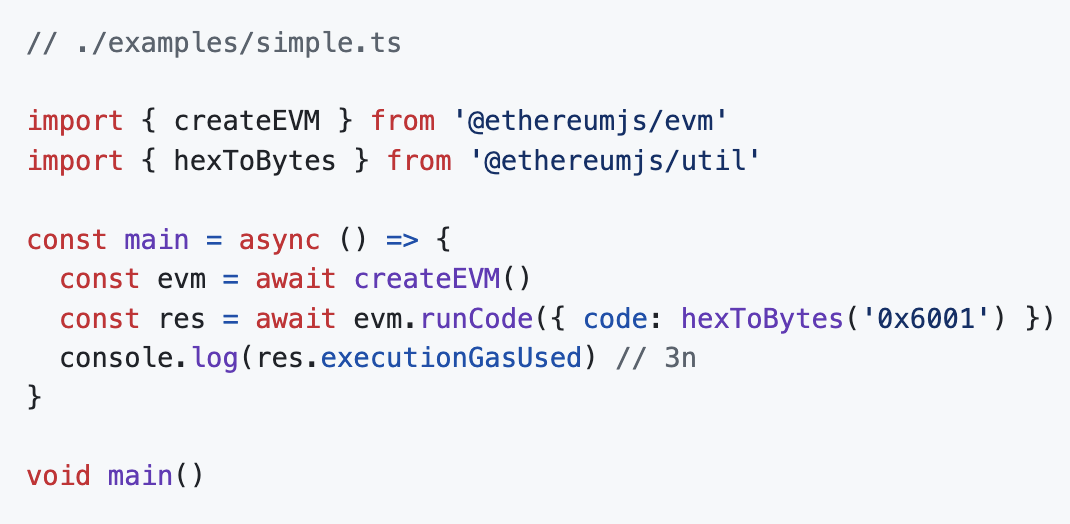
EVM usage in TypeScript
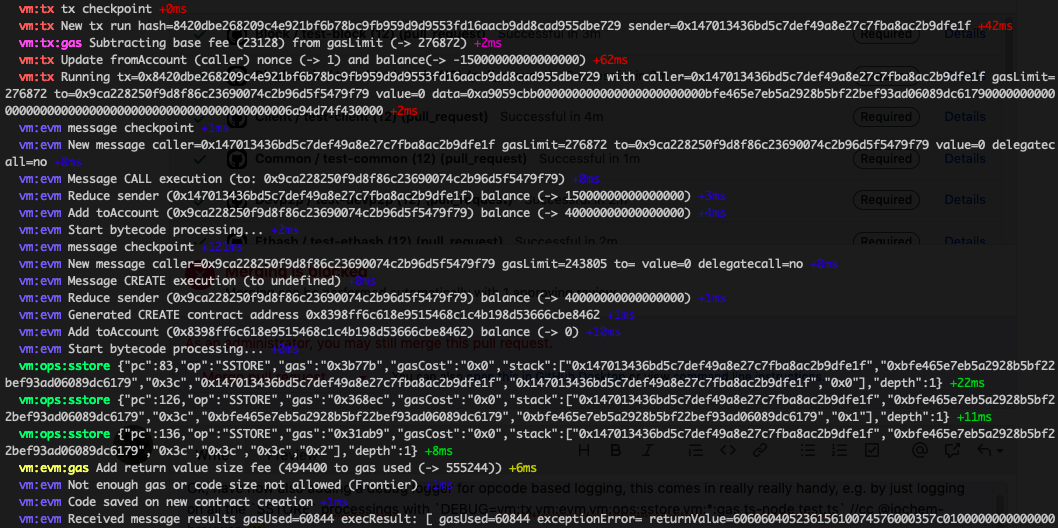
Built-in colored EVM debugging
Where it runs
dApp & tooling developers
Protocol-correct primitives in TypeScript — no reimplementing RLP, transaction formats, or EVM edge cases yourself.
Wallets & browser apps
Small bundles, WASM-free by default, runs in Node.js and the browser. Tree-shake what you need.
Researchers & EIP authors
Early EIP integrations — PeerDAS, binary tree state, Amsterdam hardfork — plus contributions to execution-spec-tests.
Educators & learners
A readable TypeScript codebase to explore how Ethereum execution actually works under the hood.
On the consensus side, Lodestar complements this stack with a TypeScript consensus client and SSZ implementations.
We've also helped close browser cryptography gaps in the ecosystem — BN254 for EVM precompiles, KZG for EIP-4844 and PeerDAS — with major contributions from @paulmillr (noble-curves, micro-eth-signer). ❤️
Join us
EthereumJS thrives on community contributions — bug reports, documentation, EIP prototyping, test cases, or a first PR. Come say hi.
You don't need permission.
Start here: Developer docs · Code of Conduct · Good first issues